Passenger Refuses Black Soldier a Seat—Then the Pilot Steps Out
Passenger Refuses Black Soldier a Seat—Then the Pilot Steps Out.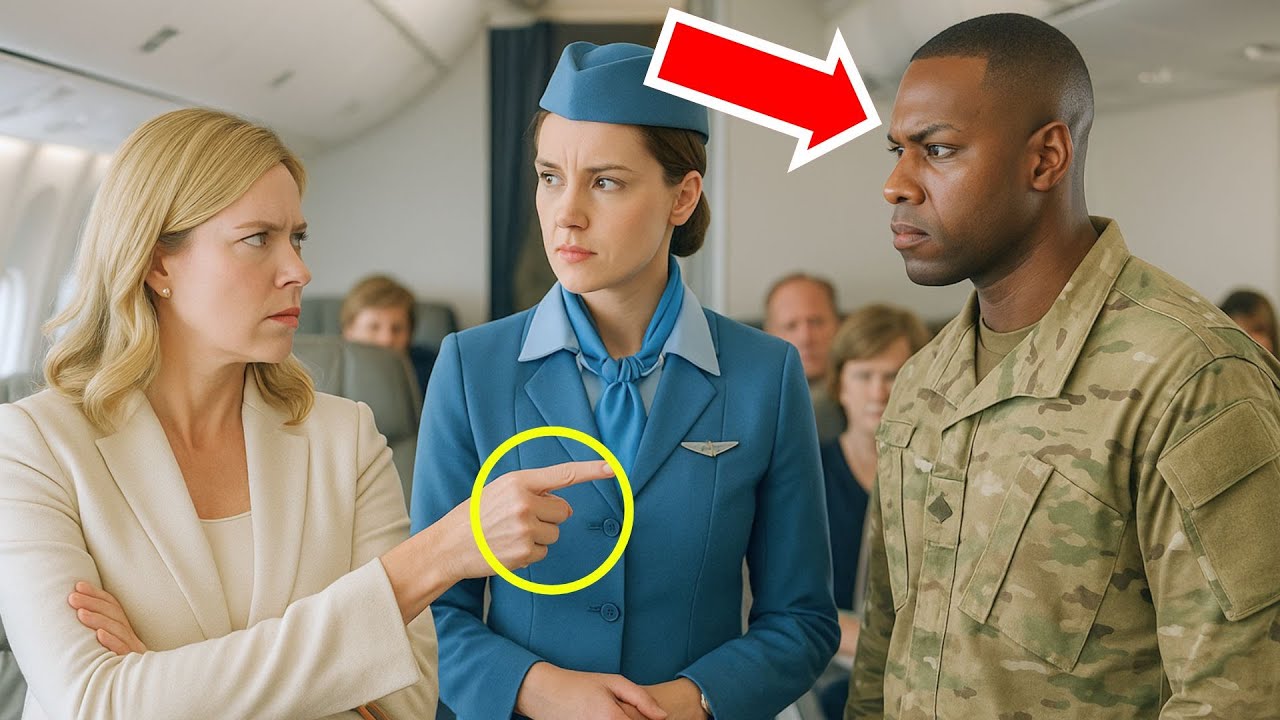
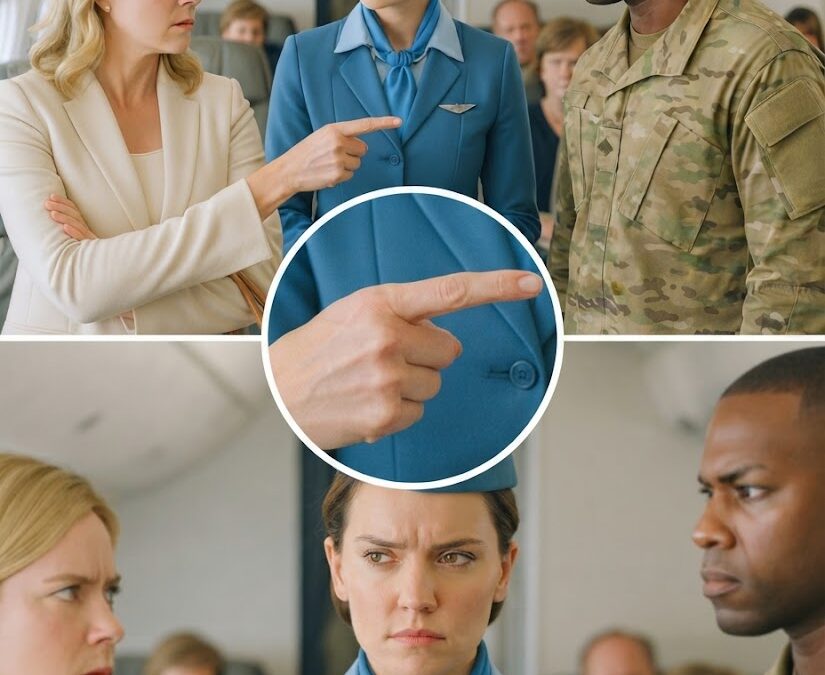
A first class ticket isn’t just a seat. For some, it’s a statement. It’s a symbol of status, a shield against the common world. For Jessica Collins, seat 2B on the transatlantic flight to London was her throne. But what happens when the person assigned to the seat next to you doesn’t fit your picture of luxury? what happens when that person is a black soldier in uniform. This isn’t just a story about an argument over a seat. It’s a story about a line being drawn in the sand at 35,000 ft. It’s about a confrontation that stopped a Boeing 707 in its tracks and a pilot who stepped out of the cockpit not just to fly a plane, but to deliver a lesson in humanity that would echo across the globe. Stay with me as we uncover how one woman’s prejudice ignited a firestorm of realworld karma she never saw coming. The air in the firstass cabin of British Airways flight 288 from Houston to London Heathrow was different. It was a curated atmosphere of quiet luxury, smelling faintly of expensive leather champagne and the subtle perfume of people who didn’t have to look at price tags. For Jessica Collins, senior vice president of Aperture Marketing, this was her natural habitat, or rather the habitat she had meticulously clawed her way into. At 38, Jessica had sculpted her life with the precision of a diamond cutter. Her blonde hair was a perfect balage. Her cream colored Kashmir travel suit was impeccably tailored, and her carry-on was a brand new Louis Vuitton Keepall that cost more than the monthly salary of the gate agents she’d just breezed past. This trip wasn’t just a vacation. It was the victory lap of a major deal she’d just closed, culminating in a meeting with her fianceé, a British financia named Robert Sterling, who was waiting for her in their newly acquired Kensington flat. She settled into seat 2B, the window seat, and immediately began her ritual. She took out a silk pillowcase, a lavender scented eye mask, and a small pouch of artisal skin care products. She was creating her bubble, a sanctuary of control and comfort for the 9-hour flight. She accepted a glass of champagne from a smiling flight attendant, Chloe, and surveyed her domain. The cabin was filling up. An older couple, likely oil money, settled into the row ahead. A tech bro already tapping away on a laptop, was across the aisle. Everything was as it should be, orderly, exclusive. Then she saw him. He was standing at the entrance to the firstass cabin holding a standard militaryissue rucks sack. He was a black man, tall and broadshouldered in his late 20s. He wore a crisp sandcoled army combat uniform, the kind she’d only ever seen in movies. On his chest were ribbons and badges she didn’t understand but instinctively dismissed. On his sleeve was the rank of a sergeant. He looked tired. the lines around his eyes speaking of a deep weariness that had nothing to do with jet lag. Jessica felt a prickle of annoyance. “A soldier?” “Yeah,” she watched as he spoke quietly to Chloe, the flight attendant, who nodded and gestured down the aisle directly towards her row. “No,” she thought, her grip tightening on her champagne flute. “Absolutely not.” Her mind raced, cataloging the possibilities. He must be lost. Perhaps he was a wounded warrior being transported, and they were just guiding him through to the economy cabin where he belonged. She had nothing against the military. Of course, she’d once liked a Memorial Day post on LinkedIn, but their place was not here. First class was for the architects of the world, the deal makers, the elite. It was a reward, a status symbol she had earned. His presence felt like a smudge on a pristine white canvas. The soldier, Sergeant Marcus Thorne, made his way down the aisle. He moved with a careful economy of motion, his rucks sack held tightly so as not tall to bump anyone. His eyes scanned the seat numbers, and then they met Jessica’s. He offered a small, polite nod. Mom, he said his voice a low, steady baritone. Looks like I’m your neighbor to see. Jessica didn’t respond. She simply stared. She looked from his face to his uniform, then to the boarding pass in his hand as if it were a forged document. The seat next to her to see was an aisle seat. her seat, her space, her bubble. “Excuse me,” he said again a little more firmly, this time, gesturing to the space he needed to pass. Jessica finally found her voice, a clipped, icy tone she usually reserved for underperforming junior staff. “I think there’s been a mistake,” Marcus paused. Mom, this is the first class cabin, she said as if explaining a complex concept to a child. I’m sure your seat is further back. Demarcus Thorne had just spent 14 months in the dust and heat of a forward operating base in a part of the world most people only saw on the news. He had led patrol survived IED blasts and held the hand of a dying friend. He had been given this surprise upgrade by a grateful airline agent in Houston who saw his deployment orders and said, “Thank you for your service, son. Let us get you home in comfort.” All he wanted was to close his eyes and imagine the moment he would see his wife Sarah and his 5-year-old daughter Maya. He was too tired for this. He held up his boarding pass. “No mistake, ma’am. Seat 2C.” Jessica recoiled as if the ticket itself were contaminated. She didn’t look at it. “I’m not comfortable with this,” she said, her voice rising just enough to be audible to the surrounding passengers. I paid a significant amount of money for this seat, for this experience. I don’t think it’s appropriate.” The tech bro across the aisle lowered his laptop screen slightly. Chloe, the flight attendant, who had been attending to another passenger, noticed the impassse and began to walk over. “Is there a problem, ma’am?” Kloe asked, her smile professionally, unwavering, but her eyes sharp. “Yes, there is,” Jessica said, finally turning her glare from Marcus to the flight attendant. “This man is insisting this is his seat. I want to see a manager. This is unacceptable.” She didn’t say the words, but everyone in the immediate vicinity heard them loud and clear. This man doesn’t belong here. Sergeant Marcus Thorne stood impassively in the aisle, his rucks sack still clutched in his hand. He felt a familiar, weary resignation settle over him. He had faced down armed insurgents with less hostility than what was radiating from the woman in seat 2B. The eyes of the other first class passengers were now on him, a mixture of curiosity, embarrassment, and a few glimmers of sympathy. He could feel the delay he was causing the disruption to the smooth, welloiled machine of pre-flight preparations. Chloe, the flight attendant, stepped gracefully into the space between them. Ma’am, I can assure you that all passengers are seated according to their assigned boarding passes, she said in a calm, deescalating tone. May I see your pass? Sergeant Marcus handed it to her. Chloe glanced at it, then back at Jessica. It’s correct. Sergeant Thorne is assigned to seat to see. Jessica’s face hardened into a mask of indignation. I don’t care what his pass says. It could be a mistake or it could be a security issue. How do we know who he is? That uniform. Anyone could buy one of those online. A gasp came from the elderly woman in the row ahead. Her husband turned fully in his seat. His brow furrowed with disapproval. Marcus’s jaw tightened, but his voice remained level. Ma’am, I am a sergeant in the United States Army returning from a deployment. I can assure you I am no threat. He reached into his breast pocket, but Kloe gently raised a hand. That won’t be necessary, Sergeant. She said, her voice now carrying a note of protective firmness. She turned back to Jessica. Miss Collins, I need you to allow the sergeant to take his seat. We need to close the cabin doors for departure. And I need you to understand that I am a platinum tier executive level frequent flyer. Jessica retorted her voice a sharp staccato. I have spent hundreds of thousands of dollars with this airline. My comfort and safety should be your priority. And I am telling you I am not comfortable. I don’t want him sitting there. The implication hung heavy and toxic in the air. him. The word was loaded with a prejudice that was as ugly as it was undeniable. She wasn’t just objecting to a passenger. She was objecting to this passenger. “And what is it about Sergeant Thorne that makes you uncomfortable?” Khloe asked, her professional veneer beginning to crack, revealing a core of steel. “I don’t have to explain myself,” Jessica snapped. “This is a premium service. I want a different seat for him or I want a different seat for me. Find one. Chloe took a deep breath. Ma’am, the first class cabin is completely full. There are no other seats. The only option is for you to allow him to sit in his assigned seat. Then you have a problem, Jessica said, crossing her arms and looking out the window. A gesture of ultimate dismissal. because I am not moving and he is not sitting here. The cabin, once a low hum of quiet conversation, was now silent. The engine spooled down slightly, a sign that the push back from the gate was being delayed. Every second that ticked by cost the airline thousands of dollars and risked a missed departure slot. The tension was thick enough to choke on. Marcus looked at Kloe, his eyes conveying a mix of apology and exhaustion. “Look,” he said quietly, “if it makes things easier, I can just go back. I don’t mind sitting in coach. I just want to get home.” The elderly man in 1A, a Texan named George Peterson, overheard him. “Don’t you dare, son,” he said his voice a low growl. You’ve earned that seat more than any of us. His wife nodded in fierce agreement. Khloe gave Marcus a grateful but resolute look. No, Sergeant, you will not be moving. You are our guest, and you will sit in the seat you were assigned. She keyed the small intercom phone on the wall. This is Chloe. I need the purser and the captain at the forward galley immediately. We have a passenger refusing to comply with crew instructions. Jessica’s head snapped back around her eyes wide with fury. Are you reporting me? Do you have any idea who I am? Before Khloe could answer, a man in a sharp suit. The cabin purser arrived, followed moments later by a presence that instantly shifted the atmosphere of the entire cabin. The cockpit door had opened, and striding into the galley was a woman with a calm, commanding demeanor. She had sharp blue eyes, hair pulled back in a severe bun, and four gold stripes on the epolettes of her pilot’s uniform. This was Captain Ava Rosttova. She was not just the pilot. She was the commander of this aircraft and everything and everyone on it fell under her jurisdiction. Her face was a mask of calm authority, but her eyes missed nothing. She took in the scene in a single sweeping glance, the defiant woman by the window. The uniformed soldier standing tiredly in the aisle, the tense flight attendant, and the silent watching passengers. “Chloe,” Captain Rostto said, her voice calm and even, yet carrying an unmistakable weight of absolute authority. “Report.” Captain Eva Rosstova listened her expression unreadable as Khloe recounted the situation in concise professional terms. She detailed Jessica Collins’s refusal to allow Sergeant Thorne to take his seat. Her insinuations about his legitimacy and her ultimate defiance of crew instructions. Throughout the report, Captain Rostova’s gaze remained fixed on Jessica, who sat with an air of entitled belligerance, as if this were all a tiresome, bureaucratic hurdle she would soon overcome. When Khloe finished, the captain took a step forward, entering the main cabin area. The confined space seemed to shrink around her presence. She was not a large woman, but she radiated an aura of command that was absolute. The rules of the ground of corporate hierarchies and platinum memberships did not apply here. Here there was only one authority. She first addressed the man still standing in the aisle. Sergeant, she said, her voice softening almost imperceptibly. Captain Ava Rostova, I apologize for this delay. Not your fault, Captain. Marcus replied, his posture straightening slightly out of instinctual respect for her rank. Captain Rostto then turned her full attention to Jessica. Ms. Collins. She began her tone a flat neutral calm that was more unnerving than any shout. I am the commander of this aircraft. My first and only priority is the safety and security of every single person on this flight. That includes the flight crew and all 247 passengers. An orderly and timely departure is part of that safety protocol. Jessica scoffed. Then you should understand. I am a paying customer and I feel unsafe. My concerns are being dismissed. I have heard your concerns,” Captain Rotova said, taking another slow step into the aisle, closing the distance between them. “You stated you are uncomfortable,” and questioned the sergeant’s legitimacy. “Let me be clear, Sergeant Marcus Thorne’s ticket is valid. His military identification is impeccable, and his presence in this cabin is not up for debate.” She paused, letting her words sink in. However, she continued, “I am also a veteran, United States Air Force. I flew C17s for 12 years before I joined this airline. I’ve flown men and women like Sergeant Thorne into and out of places you only read about in the news. I’ve flown flag draped coffins home.” A hush fell over the cabin. The tech bro put his laptop away. George Peterson and his wife leaned forward, hanging on every word. So when I see a uniform, Captain Rostto’s voice grew colder harder, like chipped ice. I don’t see a threat. I don’t see something inappropriate. I see a man who has signed a blank check payable to his country for an amount up to and including his life. I see a man who has been away from his family for over a year, serving so that people like you can have the freedom to fly to London for business meetings and shopping sprees. Jessica’s face, which had been a mask of defiance, began to show cracks. A flush of angry red crept up her neck. This is unprofessional. You’re lecturing me. No. Captain Rostova corrected her. I am educating you on the reality of this situation. You are creating a disturbance. You are disobeying the lawful instructions of a flight crew. And you are delaying an international flight with nearly 250 souls on board. According to federal and international aviation law, I have the final say on who flies on my aircraft. She leaned in slightly, her voice dropping to a low, intense level that only Jessica and those in the immediate rows could hear. This man is not the problem. His uniform is not the problem. The color of his skin is not the problem. The only problem in this cabin right now, Ms. Collins, is you. With that, she stood back up to her full height and addressed Jessica in a clear, carrying voice that echoed through the silent cabin. So, you now have two choices. Option one, you will take a deep breath. You will allow Sergeant Thorne to take his seat, and you will sit there for the duration of this flight to London in silence. Perhaps you can use that time to reflect on the concept of respect. Option two, you can collect your Louis Vuitton bag and your silk pillowcase and I will have you escorted off my aircraft immediately. You will be met by ground security and the airline will be placing you on a permanent no-fly list. She let the ultimatum hang in the air, a stark non-negotiable choice. But then she did something no one expected. She widened her address to the entire firstass cabin. And just so we’re all clear, she announced her voice ringing with authority. Out of respect for Sergeant Thorne’s service, I’d like to extend that offer to anyone else who feels uncomfortable sharing a cabin with a member of the United States Armed Forces. If anyone else would like to deplane, please let my crew know now. We’ll be happy to accommodate you. She stood there, arms folded, her gaze sweeping across the faces of the passengers. It was a master stroke. She hadn’t just confronted a bigot. She had rallied the entire cabin to the side of honor and decency, completely and utterly isolating the woman in seat 2B. The silence that followed Captain Rosttova’s declaration was profound. It was a heavy weighted silence where the collective judgment of an entire cabin was focused on one person. Jessica Collins, who had built her entire identity on being the one in control, the one who commanded attention and respect, was now trapped in a spotlight of shame. Her face was a storm of conflicting emotions, fury, disbelief, and the dawning terrifying realization that she had catastrophically misjudged the situation. For a moment she seemed to search for an ally, her eyes darting around the cabin, but she found none. The tech bro across the aisle gave a slow, deliberate shake of his head. The elderly couple, the Petersons, stared at her with open contempt. Even the professionally neutral faces of the flight attendants had hardened. She was an island, and the tide was coming in. Then something shifted. A man in seat 3A, a well-dressed businessman, unbuckled his seat belt, stood up, and reached across the aisle to Sergeant Thorne. Sergeant,” he said, his voice clear and strong. “I just want to shake your hand and thank you for your service.” Marcus, startled, shook the man’s hand. “Thank you, sir.” That one act broke the dam. George Peterson from row one called out, “God bless you, son. Welcome home.” Another passenger started a quiet, hesitant clap. It was quickly joined by another and then another until the entire firstass cabin and even some passengers in the premium economy section who could hear the commotion erupted in a wave of sustained heartfelt applause. It wasn’t just for Marcus. It was a resounding ovation for Captain Rostova and a thunderous repudiation of Jessica Collins. The sound washed over Jessica, each clap a physical blow to her ego. The applause was a verdict. She had lost. Humiliation hot and sharp coursed through her. Her meticulously constructed world with its rules of status and privilege had just been publicly dismantled by a pilot and a soldier. “This is ridiculous,” she hissed her voice a venomous whisper, though no one could hear it over the applause. I’ll be suing this airline. I’ll have your job.” She mouthed at Captain Rostto, who watched her unmoved. The applause died down. Captain Rostto’s gaze was still locked on Jessica. “Miz Collins,” she said, her voice cutting through the now quiet cabin. “I’m waiting for your decision. The clock is ticking.” Jessica’s mind scrambled for an exit strategy, a way to salvage a shred of dignity. But there was none. Staying on the plane meant enduring 9 hours of icy glares and whispered condemnation, sitting next to the very man she had tried to expel. Leaving meant the ultimate walk of shame. She chose the latter. With a jerky, furious motion, she began to gather her things, stuffing her expensive skin care products back into their pouch with trembling hands. She refused to make eye contact with anyone. She was a queen being dethroned, and the indignity was more than she could bear. “Fine,” she spat, shoving her silk pillow into her Vhuton bag. “I wouldn’t want to fly on this tinpot airline anyway.” “Excellent choice,” Captain Rosttova said coolly. She nodded to the purser. Please escort Miss Collins from the aircraft. Ensure ground security is present to receive her. The person stepped forward. This way, ma’am. Jessica Collins stood up. The entire cabin watched as she shuffled into the aisle, her face a mask of scarlet fury. As she passed Marcus Thorne, she shot him a look of pure hatred. He simply met her gaze, his expression not of triumph, but of a deep, profound pity. He saw not a monster, but a small, broken person. And in that moment, he felt nothing but relief that he wouldn’t have to sit next to her. Her walk down the aisle was the longest of her life. It was a gauntlet of silent, judging eyes. As she passed through the galley and out of the cabin door, a single passenger was heard to say, “Don’t let the jet bridge hit you on the way out.” The moment the door closed behind her, a palpable sense of relief swept through the cabin. The oppressive tension vanished, replaced by a feeling of shared decency. Captain Rostto walked back to Marcus. Sergeant Thorne,” she said, her professional demeanor softening into genuine warmth. On behalf of the entire crew of British Airways Flight 288, I want to formally apologize for that disgraceful behavior. “Welcome aboard, and welcome home.” “Thank you, Captain,” Marcus said, a genuine, tired smile finally reaching his eyes. Thank you for what you did. Just doing my job, she replied with a small smile. Now, please take your seat. You’ve been standing long enough. As Marcus finally settled into the plush leather of seat 2C, stretching out his legs for the first time in what felt like an eternity, Khloe arrived with a glass. “Sergeant,” she said, her own smile bright and genuine. I believe the captain would like to buy you a drink. We have a 2004 Dom Perinho. I think it’s appropriate for the occasion. For the first time that day, Marcus Thorne laughed. It was a deep, honest laugh of relief and disbelief. As the plane finally began its push back from the gate, he took a sip of the finest champagne he’d ever tasted, and allowed himself to believe that he was finally on his way home. While Sergeant Marcus Thorne was settling in for a muchneeded rest, and flight 288 was ascending into the night sky, the consequences of Jessica Collins actions were just beginning. Their own journey, traveling not at 600 mph, but at the speed of light. The tech bro across the aisle, a 26-year-old app developer named Ben Carter, had done what his generation does best. He had recorded it, not obtrusively, but with his phone resting on his lap. He had captured the entire exchange from Jessica’s snide. I think there’s been a mistake to Captain Rostova’s powerful ultimatum and Jessica’s humiliating exit. As soon as the plane reached cruising altitude and the Wi-Fi signal blinked on, Ben did some quick editing. He cut the video into a compelling 4-minute clip, bleeping out the flight number and blurring the faces of the other passengers, but leaving Jessica’s and the captains clearly visible. He gave it a simple powerful title, woman tries to kick black soldier out of first class. Pilot shuts her down. Must watch. He wrote a short caption explaining the context praising Sergeant Thorne’s dignity and Captain Rostova’s incredible leadership. Then he uploaded it to Twitter, Instagram, and Tik Tok tagged several major news outlets and used the hashtags welcome home. Sergeant Hamp Captain Hero and flying while black. He closed his laptop thinking it might get a few thousand views. He had no idea he had just lit the fuse on a cultural hydrogen bomb. By the time Flight 288 was over the Atlantic, the video had exploded. On Twitter, it was being retweeted by celebrities, politicians, and veterans groups. On Tik Tok, it was being stitched and dueted with users saluting their screens. On Facebook, it was being shared by millions of mothers, fathers, and grandparents, all expressing their outrage and admiration. The internet, so often a fractured and contentious place, had found two things it could unanimously agree on. Captain Eva Rosstova was a hero, and Jessica Collins was a villain. Internet sleuths with their formidable and terrifying efficiency identified Jessica within an hour. They found her LinkedIn profile which proudly listed her as senior vice president at Aperture Marketing. Within minutes, Aperture’s social media pages were flooded. Their most recent post, a cheerful graphic about synergistic brand alignment, was buried under thousands of comments demanding Jessica Collins be fired. People were posting on one-star reviews on their glass door and Google pages. The company’s name was trending on Twitter for all the wrong reasons. The CEO of Aperture Marketing, a pragmatic and socially conscious man named David Chen, was at dinner in New York when his phone began vibrating off the table. He saw a text from his head of PR that simply read, “Urrent, call me now.” He excused himself and took the call. 10 minutes later, his face was pale. He had seen the video. He had seen his star executive become the face of corporate bigotry. Meanwhile, in London, Jessica Collins fiance, Robert Sterling, was woken up by a call from a friend. Rob, mate, you need to see this. Is this Is this Jessica? Robert, groggy and confused, opened the link. He watched the video once, then a second time. He felt a cold dread creep into his stomach. The woman in the video, her face twisted with a contempt he had never seen before, was undeniably the woman he was planning to marry. Robert came from a family of immigrants. His own father had faced down the same ugly prejudice when he first arrived in the UK. To see that same venom coming from Jessica, directed at a soldier, no less, was nauseating. It was a betrayal of everything he thought she was. Back on the plane, Ben Carter showed the view counter to Marcus, whose eyes went wide. “It’s at 5 million views,” Ben said almost in disbelief. “And Captain Eva Rosstova is the number one trending topic in the world.” The news filtered through the plane. The flight attendants on their break huddled around a tablet, watching the story unfold in real time. When Captain Rostova emerged from the cockpit for a routine check, the entire crew gave her a standing ovation in the galley. She was bewildered at first, then humbled when they explained what was happening on the ground. As the plane began its descent into Heath Row, the world below was a completely different place for Jessica Collins than the one she had left 9 hours earlier. She had been tried and convicted in the Court of Public Opinion. She just didn’t know it yet. Her phone, which she would turn on as soon as she cleared customs after being rebooked on a later, much less comfortable flight, was a digital time bomb, counting down to the moment it would detonate and obliterate the life she had so carefully built. The karma wasn’t just coming. It was already there, waiting for her on the tarmac. The moment Jessica Collins’s phone connected to the Heathrow Wi-Fi, it became possessed. A relentless torrent of notifications vibrating with such intensity that the phone rattled on the table of the airport coffee shop where she was nursing her wounded pride. Hundreds of emails, thousands of social media notifications, missed calls, and frantic text messages. Her first instinct was annoyance. She assumed it was work rellated, a crisis she would have to manage from afar. Then she saw the headlines in her news alerts. Forb’s Aperture marketing executive in viral plain racist video. CNN. Who is Jessica Collins? The woman in the video seen by 50 million. The Guardian pilot hailed as hero. After removing abusive passenger from flight, her blood ran cold. She clicked on one of the links. There she was, her face contorted in an ugly sneer broadcast for the entire world to see. Her words, her entitled demands transcribed and analyzed by news anchors and social media commentators. She wasn’t just a disgruntled passenger. She was a meme, a symbol of everything wrong with the world. She was hack plain Karen. A text message from her boss, David Chen, flashed on the screen. It wasn’t a question or a request for an explanation. It was a cold final statement. Jessica, you are on immediate and indefinite administrative leave. Do not contact any clients. do not represent Aperture in any way. We will be in touch via HR. Her career, a gleaming skyscraper she had spent 15 years building, had just been leveled by a 4-minute video. Then she saw the dozens of missed calls and texts from Robert, her fianceé. She scrolled to the most recent one, her hands shaking. Jess, I saw the video. I don’t even know who you are. The person I saw is not someone I can marry or build a life with. We are done. My assistant will arrange to have your things sent from the flat. Do not try to contact me. A strangled sob escaped her lips. Her victory lap, the triumphant arrival in London to start her new life, had turned into a nightmare. She had lost her job and her fianceé in the span of 9 hours. The fallout didn’t stop there. British Airways released a formal statement. They publicly praised the exemplary conduct and decisive leadership of Captain Ava Rostova and offered a sincere apology and commendation to Sergeant Marcus Thorne. The final paragraph was a killing blow. The passenger in question, Miss Jessica Collins has been permanently banned from flying with British Airways, and our partner airlines for life effective immediately. As Jessica sat shell shocked in the crowded terminal, people were starting to recognize her. A whisper here, a pointed finger there. Someone surreptitiously tried to take her photo. The gilded cage of first class had been replaced by a ponopticon of public scorn. She fled to a bathroom stall, her heart pounding with a panic she had never known. Meanwhile, the subjects of her scorn were having a very different experience. As Sergeant Thorne deplaned at Heathrow, he was met not only by his ecstatic wife and daughter, but by a representative from the airline and a swarm of British reporters. Flustered but gracious, he gave a short statement. He spoke not of Jessica, but of the kindness of the crew and Captain Rostova. He talked about how much he missed his family and how proud he was to serve. His quiet dignity was a stark contrast to the ugliness seen in the video, and it only endeared him more to the public. Within days, a GoFundMe started by a veterans group to give Sergeant Thorne the welcome home he deserves raised over $100,000. offers poured in for his family, all expenses paid, vacations, scholarships for his daughter, even a job offer from a security firm for whenever he decided to leave the military. He had become a reluctant national hero. Captain Ava Rosttova, a private person by nature, was also thrust into the spotlight. The airline featured her in a new ad campaign celebrating their staff. She received thousands of letters and emails, many from young girls who said she inspired them to want to become pilots. A book publisher offered her a deal for a memoir about her life and career. Her single decisive act of integrity had turned her into an icon. Jessica Collins’s fate was sealed a week later. Aperture Marketing’s board held an emergency meeting. The damage to their brand was catastrophic. Clients were threatening to pull their contracts. They issued a public statement announcing that Jessica Collins had been terminated effective immediately. Their statement read, “The values on display in the video are the antithesis of what Aperture stands for. We believe in respect, inclusivity, and honor for our service members. There is no place in our organization for hate or prejudice of any kind. Jessica, now stranded in a soulless London airport hotel, read the news on her laptop. She had nothing. Her reputation was in ashes. Her career was over. Her relationship was destroyed. She had boarded flight 288 as a queen on her throne. She now found herself a pariah with a one-way ticket to rock bottom. The karma hadn’t just hit back. It had used a sledgehammer. A year is a length of time, both fleeting and eternal. For the passengers of flight 288, the incident had become a fading, shocking memory, a story told at dinner parties. For the wider world, it was a viral moment consumed and replaced by the next cycle of outrage and admiration. But for the three individuals at the heart of the storm, Jessica Collins, Marcus Thorne, and Eva Rostova, that single day on the tarmac in Houston had become a fixed point in time, a singularity that had bent the ark of their lives, sending them hurtling down three vastly different trajectories. The ghost in Maple Creek, Jessica Collins, now lived in Maple Creek, Ohio, a town she chose for its profound and suffocating anonymity. Her two-bedroom luxury condo in Houston with its floor to-seeiling windows and skyline views had been replaced by a cramped one-bedroom apartment above a laundromat. The air, perpetually thick with the clawing scent of fabric softener, was a constant reminder of her fall. The cream cashmere and Vuitton leather had been sold on consignment websites for pennies on the dollar, replaced by generic, ill-fitting clothes from Target and Walmart. Her life was a monotonous loop of shame. She awoke each morning not to the chime of her smart home assistant, but to the rumbling vibrations of the washing machines downstairs. Her work was no longer about crafting multi-million dollar marketing campaigns. It was about churning out soulcrushing, algorithm-pleasing digital content under the pseudonym Jenna Peterson. She wrote articles like 15 surprising uses for baking soda and how to write the perfect cover letter. A task of such bitter irony it sometimes made her laugh a dry rasping sound that felt foreign in her own throat. Her identity had been erased, but the memory of who she was and what she had done was a relentless tormentor. She suffered from a unique self-inflicted form of paranoia. In the sterile aisles of the local Kroger, she would see a teenager glance down at their phone and feel a jolt of pure panic, her heart hammering against her ribs. Are they watching it? Do they know who I am? The video was her digital ghost, a permanent, unex exercisable phantom that haunted every corner of the internet. One bleak Tuesday afternoon, the fragile dam of her composure finally broke. She was in line at the post office waiting to mail a tax document when the man behind her, a burly construction worker, sighed with impatience. “Come on, lady. Some of us have to work for a living,” he grumbled. Something inside Jessica snapped. The humiliation, the rage, the injustice she felt had been done to her. It all came boiling to the surface. She whirled around her eyes, blazing with the fire of the old Jessica Collins. “Do you have any idea who I am?” she shrieked, her voice cracking. The handful of people in the post office stared stunned into silence. The man blinked, taken aback. “Uh, no. And I don’t care. Just move up the line.” “I was a senior vice president,” she screamed, tears of fury and self-pity streaming down her face. “I had a life. I had everything. and it was stolen from me by the media, by the woke mob, by everyone who wanted to tear me down. The postal worker, a weary woman named Brenda, peered over her glasses. Ma’am, if you don’t calm down, I’m going to have to ask you to leave. Jessica’s tirade dissolved into ragged sobs. She wasn’t a lioness anymore. She was a caged, wounded animal. She fled the post office, the burn of a dozen pairs of eyes on her back. They weren’t staring because they recognized her from a viral video. They were staring at a woman having a complete and total breakdown in public. In that moment, she realized the devastating truth. She was no longer famous or infamous. She was just nothing. a nobody in a nowhere town. Her attempts to reclaim her life had been pathetic and futile. Early on, she had sought legal counsel convinced she was the victim. She found a small town lawyer named Stan Gable, whose office smelled of stale coffee and desperation. He listened to her story, his face impassive. So, let me get this straight, Miss Collins,” Stanard said, leaning back in his creaking chair. “You want to sue the airline for what?” Exactly. Upholding federal aviation law, for humiliating me, for discriminating against me, she had insisted. “They offered you a choice,” Stan counted, holding up his hands. “Sit down or get off. You chose to get off. That’s not discrimination. That’s compliance. And as for the fellow who filmed it, in most states, there’s no expectation of privacy in a public place, which the cabin of a commercial airliner is considered to be. You have no case. Zero. In fact, if you tried to sue, they’d likely counter sue for the cost of the flight delay you caused. The blunt, unvarnished truth had been another nail in the coffin of her old identity. There would be no redemption tour, no triumphant legal victory. There was only this, the low rent, the anonymous by lines, and the gnawing emptiness. Late one night, unable to sleep, she typed her own name into Google for the thousandth time. She scrolled past the news articles, the hate-filled blogs, the Where Are They Now videos. She found a recent interview with Sergeant Thorne. He was smiling, standing with his arm around his wife, his daughter on his shoulders. The article spoke of his charity work, his quiet strength, his grace. He was asked in passing about the woman on the plane. His response was simple. I hope she found peace. The words hit Jessica with the force of a physical blow. Peace. It was the one thing she didn’t have. It was the one thing she had freely taken from herself. For the first time, the towering wall of her anger and resentment crumbled, leaving her exposed to the cold, stark reality of her actions. It wasn’t the mob or the media that had destroyed her life. It was her, her prejudice, her arrogance, her refusal to see the humanity in the man standing in the aisle. In the crushing silence of her apartment, surrounded by the ghosts of her former life, Jessica Collins finally began to weep, not for what she had lost, but for what she had done. The builder in Austin, 2,000 m away in the warm, vibrant city of Austin, Texas, Sergeant Marcus Thorne was learning to be Marcus again. The transition from the rigid structure of military life to the fluid chaos of civilian life was a challenge, but one he met with the same steady resolve he’d applied to everything else. The viral fame was a strange, uncomfortable coat he was forced to wear for a time. He and his wife Sarah had beenounded by media requests and overwhelmed by the sudden influx of money from well-wishes. But Marcus was a builder, not a celebrity. He and Sarah used the funds not for extravagance, but for foundation. They bought a modest but beautiful home with a yard for their daughter Ma to play in. They set up a college fund for her that guaranteed she would never have to worry. And they invested the rest, securing a future that had once seemed uncertain. The real transition happened not in his bank account, but in his purpose. He took a position as a senior counselor at the Forward Path, a nonprofit dedicated to helping veterans navigate the complexities of returning home. He had found a new mission. His office was simple, decorated with Meer’s crayon drawings and a single framed photo of his old unit. One afternoon, he was counseling a young Marine, a kid of 22 named Corporal Diaz, who had lost a leg in an ambush and was now battling a storm of anger and resentment. “They don’t get it, man,” Diaz said, his voice roar. People thank me for my service, but then they stare at my prosthetic. They cut me off in traffic. They treat me like I’m broken or I’m about to sap. I just want to scream at them. Marcus nodded slowly, recognizing the rage. He leaned forward. Let me tell you a story, he said. He recounted the incident on the plane, not in the triumphant way the media had portrayed it, but from his perspective. The bone deep weariness, the sting of humiliation, the effort it took to remain calm when every combat instinct was telling him to react. This woman, Marcus explained, she looked at me, and she didn’t see a person. She saw a threat, a symbol, something that didn’t belong in her world. My first thought was anger, pure hot rage. I wanted to tell her exactly who I was and what I’d done. I wanted to make her feel as small as she was trying to make me feel. So why didn’t you? Diaz asked, leaning in captivated. Because my dignity is mine, Marcus said, tapping his own chest. It’s the one piece of armor no one can take from you unless you give it to them. The moment I would have yelled, the moment I would have lowered myself to her level, I would have lost. She would have gotten exactly what she wanted proof that I was the inappropriate person she thought I was. By staying calm, by being the professional soldier I was trained to be, I held on to my power. I let her be the one who fell apart. He looked Diaz in the eye. That anger you’re feeling is a weapon, son. Right now, you’re pointing it at yourself. You need to learn how to unload it or aim it at something constructive. Your fight isn’t with a rude driver or a person who stares. Your fight is for your own peace. In that moment, Marcus understood the true purpose of what had happened. The incident wasn’t a curse of unwanted fame. It was a crucible that had forged a testimony. It gave him a unique key to unlock the pain in other veterans to connect with them in a way no civilian therapist ever could. He was no longer just a soldier. He was a healer, a guide, using the scars of his own experience to help light the path for others. His life was full. He coached Meer’s soccer team. He and Sarah went out for date nights, and he found a profound, quiet satisfaction in the work he did. He had come home in every sense of the word. The commander’s new bearing, for Captain Ava Rostto life had become a delicate balancing act between the cockpit and the public stage. She had reluctantly embraced her new role as a symbol of integrity. Her book, Clear for Takeoff, had been a runaway success. Its message of calm, decisive leadership, resonating far beyond the world of aviation. She used her platform with the same precision she used to land a 400 ton aircraft in a crosswind. A significant portion of her book proceeds went to a charity that provided scholarships for aspiring female pilots. She worked tirelessly with airline executives to rewrite and implement stronger, more compassionate training protocols for flight crews. One Saturday morning, she was the keynote speaker at an outreach event for girls in aviation. The hanger was filled with hundreds of young, eager faces, all dreaming of the sky. After her speech during the meet and greet, a small girl no older than 10 with bright intelligent eyes came up to her clutching a copy of her book. “Captain Rostova,” the girl said shily. “Just Eva is fine,” she replied, kneeling down to be at her eye level. “I read your book. My mom helped me with the big words,” the girl said. “I read what you did on that plane. You were so brave. You didn’t yell. You were just in charge. My dad says you have a command presence. Eva smiled. Well, your dad’s a smart man. When I grow up, the girl said, her voice filled with conviction. I want to be a pilot. I want to be the one in charge, just like you. The simple, powerful sincerity of the girl’s words struck even more deeply than any award or accolade she had received. This was the real legacy of that data day. It wasn’t about punishing one ignorant woman. It was about inspiring a new generation. It was about showing this young girl and thousands like her that a woman could be the ultimate authority, a leader whose strength was rooted not in aggression but in unshakable integrity. She and Marcus had kept in touch, forming an unlikely but powerful friendship. They had done one joint television interview for a Veterans Day special. The host had tried to bait them into condemning Jessica Collins further, but they refused. “Our lives are defined by what we build, not what we tear down,” Eva had stated calmly. “That incident was a moment, a regrettable moment. But what matters is what came after. Sergeant Thorne is building a community for veterans. I’m trying to build a more respectful, inclusive culture in my industry. That’s the story. The echoes of flight 288 had finally settled. They were no longer the chaotic crashing sounds of a viral storm, but the quiet, resonant chimes of consequence. For Jessica, it was the sound of a door slamming shut. For Marcus and Eva, it was the sound of new doors opening wide, leading them to futures they had never imagined. Futures built not on the privilege of a first class ticket, but on the enduring value of human decency. The fall from 35,000 ft had been devastating for one, but for the others it had simply cleared the way for them to soar even higher. This story is a powerful reminder that the realworld consequences of our actions can be swift and unyielding. Jessica Collins didn’t just lose an argument on a plane. Her prejudice cost her everything her career, her relationship, and her reputation. In contrast, Sergeant Thorne’s quiet dignity and Captain Rostova’s unwavering integrity didn’t just win the moment. They inspired millions. It shows that in today’s world, there are no small acts of hate, just as there are no small acts of courage. A camera phone in the right hands can become a powerful tool for justice, ensuring that karma is no longer a concept, but a tangible lifealtering force. If you believe in standing up for what’s right and celebrating everyday heroes like Captain Rostova and Sergeant Thorne, please show your support. Hit that like button. Share this story with someone who needs to hear it and subscribe to our channel for more incredible true stories of justice and karma. And let us know in the comments below what would you have done in that situation.
You Might Also Enjoy

Gerente de companhia aérea se recusa a permitir que mãe e filho negros sentem juntos — anúncio do piloto muda…
Comissária de bordo joga fora a passagem de um passageiro negro — apenas para descobrir que ele é o dono da companhia aérea.

Passageiro agride adolescente negro na primeira classe — anúncio do piloto segundos depois deixa todos em silêncio.

Flight Crew Questions Black Woman’s First-Class Ticket — Airport Security Salutes Her as Judge!